Access Tokens
info
To call epilot APIs, requests must be authorized using a valid Access Token.
Using Access Tokens
Pass the access token in the Authorization request header:
Authorization: Bearer <your-access-token>
Creating Access Tokens
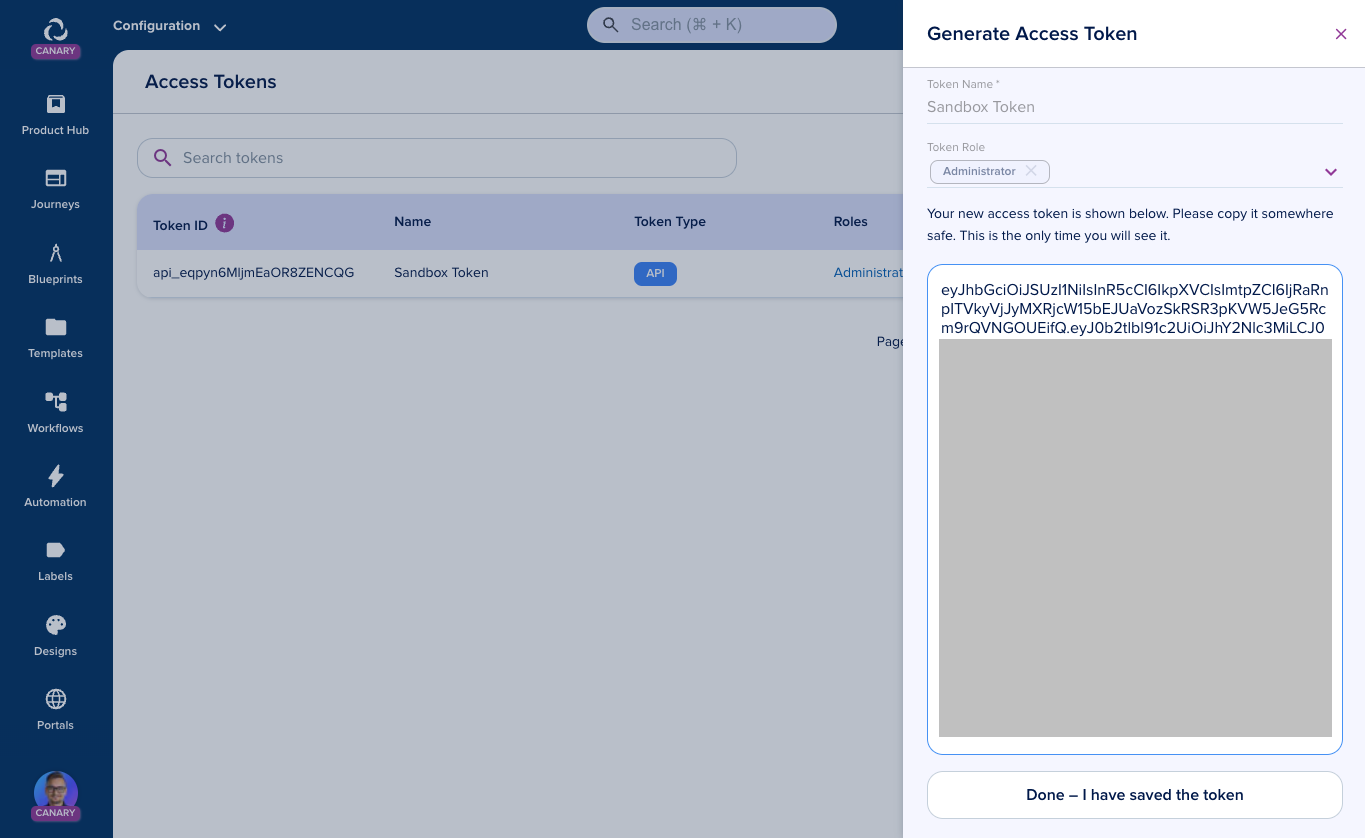
Manage Access Tokens from Settings > Access Tokens in the epilot 360 app. Creating tokens requires the token:create permission.
By default, a new Access Token inherits the roles and permissions of the creating user.
When creating a token, you can optionally set an expiry. A token with an expiry is automatically invalidated once it passes; a token created without one remains valid until revoked. Setting an expiry is recommended to limit the impact of a leaked token.
note
The generated token is shown only once and must be saved by the user.
Restricting Access Tokens
Two options restrict what a token can do, independently of its roles. Both are set when the token is created, are enforced server-side, and can't be switched off by the token holder.
Read-only tokens
A token created with Read-only (read_only: true) can perform read actions only. Every write action is denied, regardless of the token's roles.
Anonymized tokens
A token created with Anonymize (anonymize: true) receives PII-anonymized entity data: names, emails, phone numbers, addresses, IBANs, and other personal data are replaced with pseudonyms in every Entity API response. Entity exports are blocked for anonymized tokens.
Anonymization is best effort
Standard fields are masked automatically, but custom attributes are only masked when they are recognized as personal data or marked Anonymize in the entity schema. Read PII Anonymization to learn what is covered and how to classify your attributes before you hand an anonymized token to an AI assistant or a third party.
Combine both options for AI assistants and analytics integrations: an anonymized token can't write pseudonyms back over your real data if it is also read-only.
Revoking Access Tokens
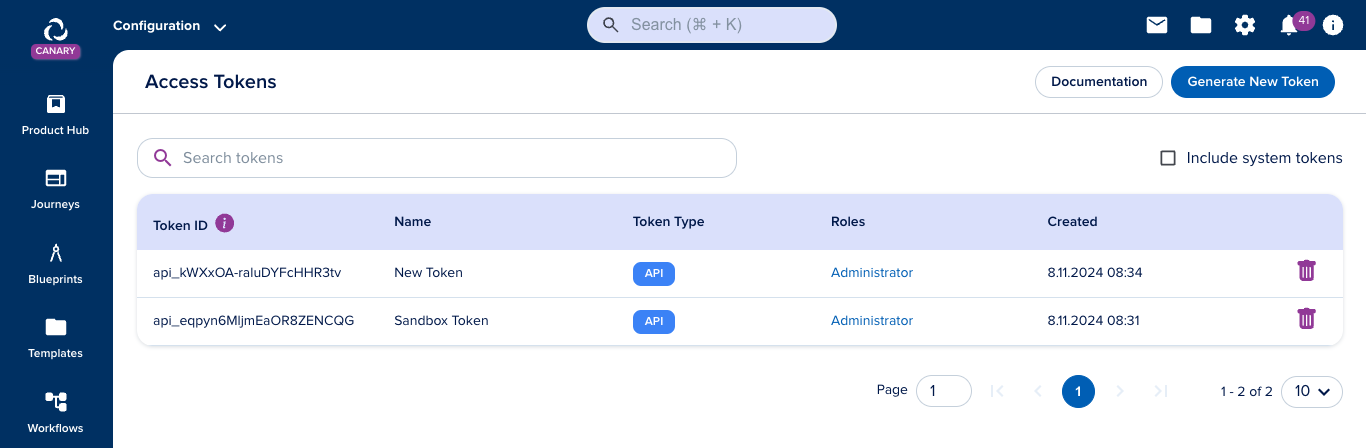
Delete an Access Token from the management view to revoke it. After revocation, the token is immediately invalidated.
caution
epilot doesn't store and cannot recover lost or revoked access tokens.
Access Token API
Generate access tokens programmatically using the Access Token API createAccessToken operation:
POST /v1/access-tokens
{
  "name": "Token for my application"
}
Optionally, pass a list of Role IDs to scope the token to specific roles. By default, the token inherits the caller's roles.
POST /v1/access-tokens
{
  "name": "Postman Access Token",
  "assume_roles": ["123:owner"]
}
Set an optional expiry with the expires_in parameter — a number of seconds (e.g. 3600) or a duration string with time units (e.g. '10h', '7d', '2 days'), bounded between 30 seconds and 365 days. Without expires_in, the token does not expire.
{
  "name": "Postman Access Token",
  "assume_roles": ["123:owner"],
  "expires_in": "30d"
}
Set read_only: true or anonymize: true to create a restricted token:
{
  "name": "AI analytics",
  "read_only": true,
  "anonymize": true,
  "expires_in": "7d"
}
A token created by an anonymized token is always anonymized too, whatever the request body says.
Tokens created with expires_in are stored, listed, and revocable exactly like non-expiring tokens. The response includes an expires_at timestamp, and the token stops working — and drops out of the token list — once it expires:
{
  "id": "api_5ZugdRXasLfWBypHi93Fk",
  "created_at": "2019-08-24T14:15:22Z",
  "expires_at": "2019-09-23T14:15:22.000Z",
  "name": "Postman Access Token",
  "assignments": ["123:owner"]
}
Each Access Token generated via the API receives a unique ID.
{
  "id": "api_5ZugdRXasLfWBypHi93Fk",
  "created_at": "2019-08-24T14:15:22Z",
  "name": "Postman Access Token",
  "assignments": ["123:owner"]
}
Revoke access tokens using the revokeAccessToken operation:
DELETE /v1/access-tokens/api_5ZugdRXasLfWBypHi93Fk
{
  "id": "api_5ZugdRXasLfWBypHi93Fk",
  "created_at": "2019-08-24T14:15:22Z",
  "name": "Postman Access Token",
  "assignments": ["123:owner"]
}
See Also
- Token Types — comparison of all epilot token types
- PII Anonymization — how anonymized tokens mask personal data
- Authentication — OAuth 2.0 login flow
- Permissions — role-based access control and grants