Payload Structure
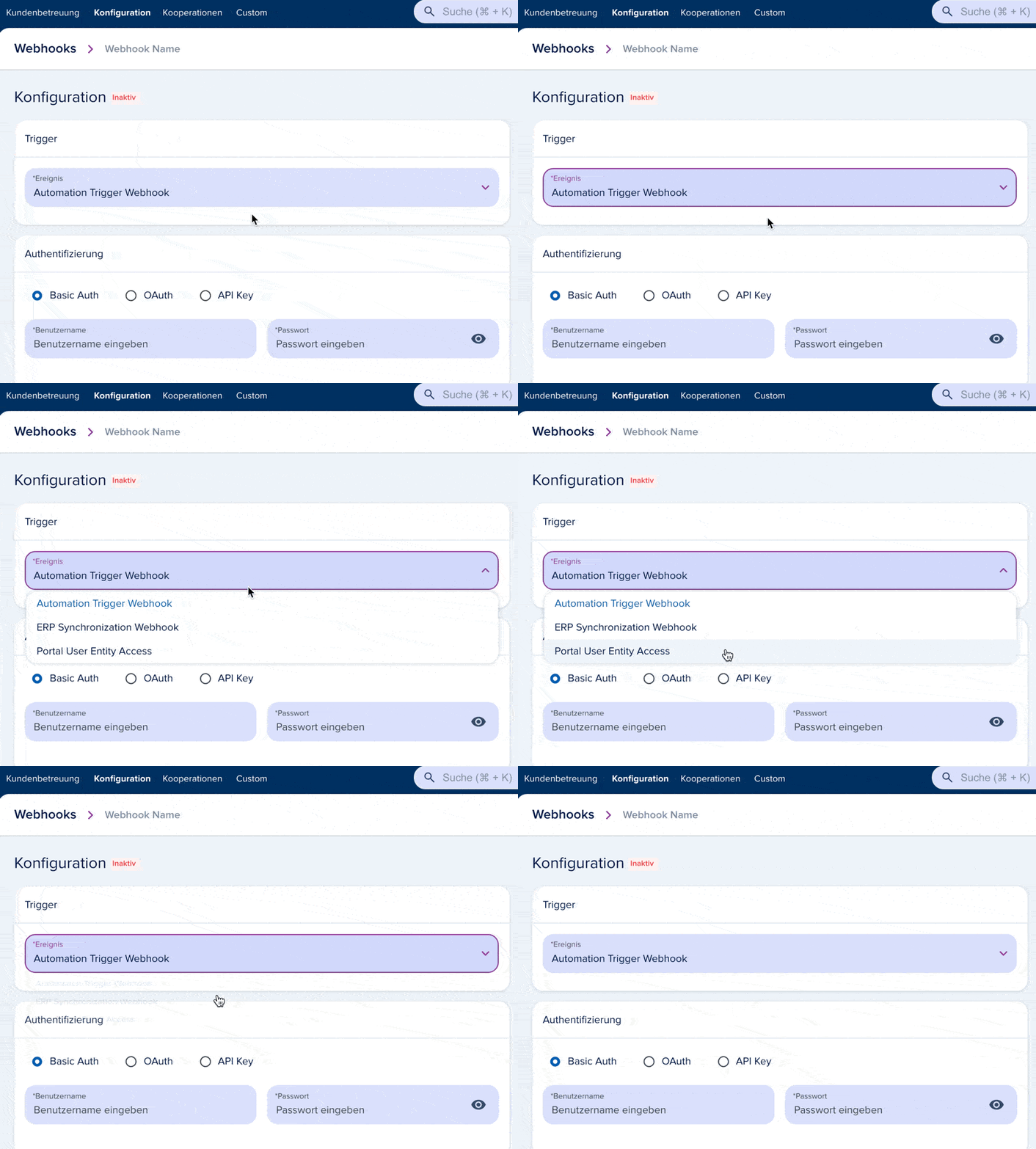
Webhook payloads vary by trigger type. The two trigger types are:
- Automation Trigger Webhook — Fires when an automation action sends a webhook request. This is the most common trigger.
- Portal User Access — Fires when a user accesses an entity in the portal.
Every payload contains a metadata object with the organization ID and event context. The entity object holds the primary entity data. The relations and activity objects are optional and depend on the webhook configuration.
tip
For events that carry files (e.g. File Created), a webhook can also deliver the actual file bytes — as Base64 in the JSON payload or as multipart/form-data. See File Data Delivery.
Webhook payload structure
{
   "metadata": {
      "organization_id": "org_1234567890",
      "event_type": "automation_trigger_webhook",
      "timestamp": "2023-10-01T12:00:00Z"
   },
   "entity": {
      "_id": "123456",
      "_schema_": "opportunity",
      "name": "New Opportunity",
      "status": "open"
   },
   "relations": [
      // optional relations to other entities
   ],
   "activity": {
      // optional activity data
   },
   "changed_attributes": {
      "added": {},
      "deleted": {},
      "updated": {}
   }
}
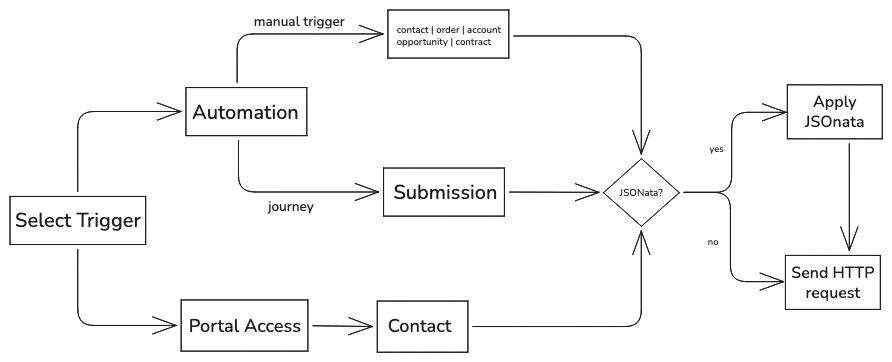
The overall flow works as follows:
- Configure a trigger for the webhook
- Portal Access triggers fire on every portal user login
- Automation Trigger triggers fire when connected to an automation action
- Optionally configure a JSONata expression to transform the payload before delivery
Main Entity
Every webhook payload includes a main entity in the entity object. The entity type depends on the trigger:
- Portal User Access — The
entityobject contains the contact entity of the user who accessed the portal. - Automation Trigger — The
entityobject contains the entity that the automation was triggered on (e.g., a contact, opportunity, or order).
Webhook Fields
The payload sent to the webhook URL contains the following fields (assuming no JSONata transformation is applied):
| Field | Type | Description |
|---|---|---|
metadata | object | Contains metadata about the configured event |
metadata.action | string? | Action that triggered the event |
metadata.origin | string? | Origin of the event |
metadata.creation_timestamp | string | Time of event creation |
metadata.webhook_id | string | The ID of the webhook configuration |
metadata.webhook_name | string? | The name of the webhook configuration |
metadata.automation_name | string? | The name of the automation that triggered the event |
metadata.organization_id | string | The ID of the given organization |
metadata.user_id | string? | The ID of the user for manual triggered events |
metadata.correlation_id | string | ID used to track the event |
metadata.execution_id | string? | When triggered by an automation this is its execution id |
metadata.action_id | string? | When triggered by an automation this is the id of the action |
entity | object | The main entity data relevant to the event |
relations | array? | Optional relations to other entities |
activity | object? | Optional activity data |
changed_attributes | object? | The attributes that were added, deleted, or updated |